

Light sails and sail lights: Lighting technology, construction, and design principles
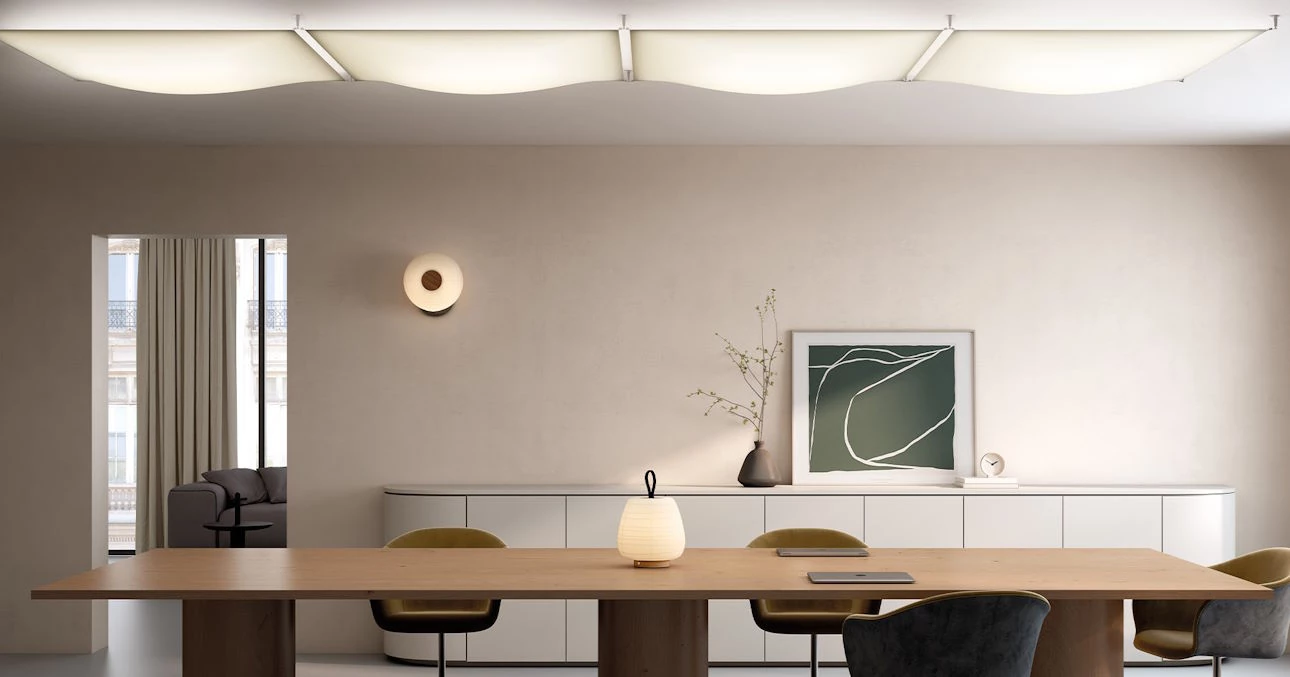
Light sails represent an architectural solution in lighting design that combines functional design with high light quality. In spaces where a glare-free and harmonious atmosphere is desired, the light sail acts as a large-scale diffuser. It refracts the point-source light from the lamps and distributes it evenly throughout the room. This reduces harsh shadows and significantly enhances visual ergonomics – a decisive advantage for well-being in residential areas as well as for concentration in workspaces.
Lighting fundamentals and the evolution through B.lux Veroca
The history of this lighting category is inextricably linked to the Veroca model. Designed in 1986 by Miguel Ángel Cigala for the Spanish manufacturer B.lux, it is considered the original prototype of the light sail. The pioneering concept of tensioning a textile membrane across four corner points using spring tension in front of a technical light source remains a design classic in lighting architecture today.
Approximately seven years ago, a technological transition began: traditional fluorescent tubes were replaced by high-efficiency LED technology. This process is now fully complete. While maintaining the same proven construction, these modern LED systems offer significantly higher energy efficiency and more homogeneous illumination of the entire fabric surface.
Quick Facts:
In modern architecture, light sails are used not only for homogeneous illumination but also to improve room acoustics.
For a detailed technical classification and physical properties, please refer to the Wikipedia article on light sails.
Areas of application and architectural use
Due to their versatile properties, light sails are used in a wide variety of environments:
- Private living spaces: Creating indirect, soft lighting in living rooms or bedrooms.
- Offices & workstations: Ensuring standard-compliant, glare-free illumination without reflections on displays.
- Public buildings & foyers: Representative lighting design in spacious rooms, museums, or entrance halls.
- Hospitality & gastronomy: Creating an inviting atmosphere through large-scale light design.
Technical specifications: transmission, acoustics, and safety
- Light direction & transmission: Use of specialized textiles with an optimized transmission rate for maximum light yield while avoiding "hotspots."
- Fire protection (DIN 4102 B1): Materials are certified as flame-retardant, a requirement for use in public buildings.
- Acoustic effectiveness: The tensioned textile acts as a sound absorber, reducing reverberation in modern architecture (glass, concrete).
- Maintenance: Sail fabrics are removable and washable at 30 °C (delicate cycle), ensuring long-term brilliance.
Conclusion
Light sails have established themselves as a durable solution for complex lighting tasks. Through the combination of proven construction principles and current LED technology, they provide functional lighting that integrates unobtrusively into various interior concepts. Whether as a standard version or a custom-made solution, they enable soft light while taking into account room acoustics and fire protection requirements.
Further information
Useful facts
Custom solutions

Care & cleaning